
A homeowner has a bailiff document that their roof collapsed after a storm. The photos are damning, and a structural assessment confirms that the property is dangerous. They file a claim for a property tax reduction.
The tax authorities respond that the damage occurred in March and the house could have been occupied from January to March, so the involuntary vacancy did not cover the entire year. This type of refusal, based not on the condition of the property but on how long it was uninhabitable, catches out homeowners every year who thought they had a strong case.
The real challenge is not proving the physical damage. It is demonstrating that the property was unoccupied through no fault of the owner for a sufficiently long period to justify the requested exemption or reduction.
Disputed period of uninhabitability: the real battleground with the tax authorities
The tax authorities distinguish between two situations. A property that is uninhabitable on January 1 of the tax year may qualify for a property tax reduction proportional to the period it remains unoccupied. If a property becomes uninhabitable during the year, however, the reduction applies only from the first day of the month following the damage or the start of the work.
The catch is that the tax inspector does not look only at photos of cracked walls. They check whether the owner can prove that the property could not be lived in or rented out for at least three consecutive months, and that the vacancy was not a matter of choice.
Claims are often rejected when the owner submits a dated technical assessment but provides no evidence about the period before or after the inspection. The tax authorities then interpret the lack of information as a lack of proof, not as confirmation. To prove that a house is uninhabitable, you need to document a timeline, not just provide a snapshot of its condition.
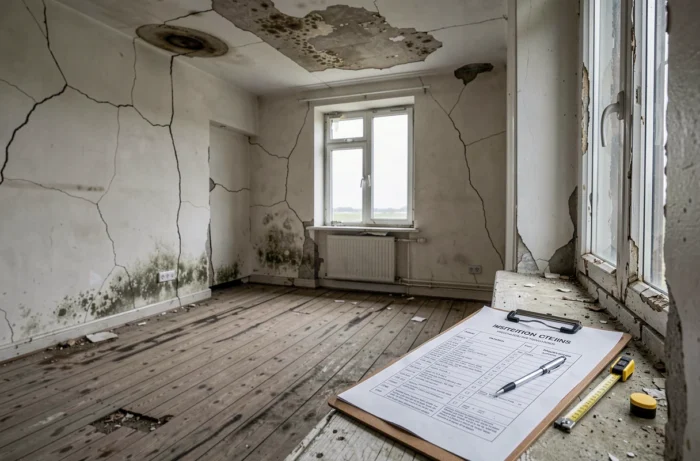
Evidence for an uninhabitable house: the documents that really carry weight
Not all supporting documents carry the same weight. A letter from the mayor reporting an imminent danger carries more weight than a sworn statement. A bailiff’s report with timestamped photos is more compelling than a simple album of phone pictures.
Here are the documents that can significantly strengthen a claim:
- A danger or unsanitary conditions order issued by the local council. This is the hardest evidence for the tax authorities to challenge because it comes from a public authority.
- Energy bills (electricity, gas) showing no consumption at all for several months, corroborating that the property was genuinely unoccupied.
- A structural assessment or bailiff’s report, dated and detailing the damage (collapsed roof, sagging floor, electrical system out of service).
- Quotes or invoices for repair work, documenting the repairs required and how they were carried out over time.
- Insurance certificates referring to damage that made the property unfit for habitation.
Consistency between the dates on the various documents is crucial. A bailiff’s report from June, a repair invoice from September and utility readings showing zero consumption from March to December form a body of evidence that is difficult for the tax authorities to dismiss.
Property tax and tax on vacant homes: two claims, two different standards of proof
Property tax reductions are often confused with exemptions from tax on vacant homes. Both may apply to the same property, but the evidence requirements differ.
Property tax reduction for an uninhabitable house
The owner must show that the property cannot be used—neither lived in nor rented out—and that this situation resulted from circumstances beyond their control. The tax authorities check that the owner did not deliberately allow the property to deteriorate to avoid paying tax. A prolonged lack of maintenance with no steps taken to restore the property will count against the claimant.
The claim must be submitted to the local property tax office, together with supporting documents, by December 31 of the year following the year in which the tax was assessed.
Exemption from tax on vacant homes
For the TLV or THLV, the vacancy must be involuntary. A property may be exempt if it is uninhabitable because of its condition, but the owner must prove that it cannot be made habitable without carrying out work whose cost exceeds a significant proportion of the property’s value.
Unsuccessful property management agreements or unanswered property listings can support the claim, but they are not enough on their own if the property is physically fit to be occupied.
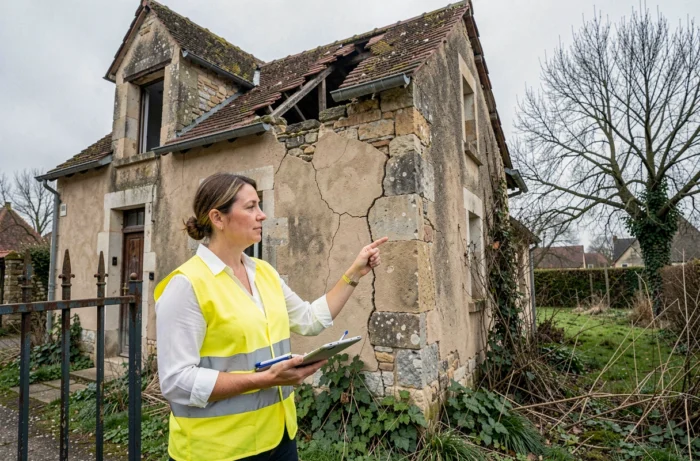
Tax claim for an uninhabitable property: mistakes that can sink your case
Certain mistakes crop up repeatedly in rejected claims.
The first is filing a claim without specifying the exact period of uninhabitability. Writing “my house has been uninhabitable since the work began” without giving dates leaves the tax authorities to determine the period themselves, often to your disadvantage.
The second is submitting only photos, with no independent documentation. Personal photos prove neither when they were taken nor the technical severity of the damage. An expert’s report or a bailiff’s report places the facts on a verifiable footing.
The third is confusing improvement work with work needed to make a property habitable again. Energy-efficiency upgrades or an extension do not make a property uninhabitable for tax purposes. The tax authorities clearly distinguish between work that prevents any occupation (structural repairs, complete roof replacement) and work that improves an otherwise functional home.
The strongest claim combines a document from a public authority (an order or report from an accredited expert), utility bills showing the property was unoccupied, and a clear timeline linking the damage or work to the declared vacancy period. Without this chronological consistency, even a visibly dilapidated property may still be taxed.