
One morning, you open your phone and see three notifications about the same event, each with a different angle. A social network shows a video clip without context. An AI tool offers a two-sentence summary. And the website of a national newspaper explores the story in depth over three screens of scrolling. Keeping up with world news is no longer just a matter of choosing a newspaper: often without realizing it, we build a news routine whose quality depends on how we balance these channels.
Passive exposure and active engagement: two ways of following the news that shouldn’t be confused
The Reuters Institute’s Digital News Report 2026 finds that social networks and video platforms have now overtaken news websites and apps as the main way people access news in the markets studied. You come across a political story or an international incident while scrolling through a feed, without having searched for it.
The European Parliament’s 2025 Eurobarometer on social networks confirms this trend: many users encounter political and social news while browsing, without having looked for it. Incidental exposure is not the same as understanding an event. Seeing a headline go by, even with a video, doesn’t provide the geopolitical context or explain the real-world consequences of a decision.
The first step toward a reliable routine is to recognize these two modes. When you browse 1 Monde’s news after coming across a story on social media, you move from passive exposure to intentional reading, with a clearly identified editorial framework.
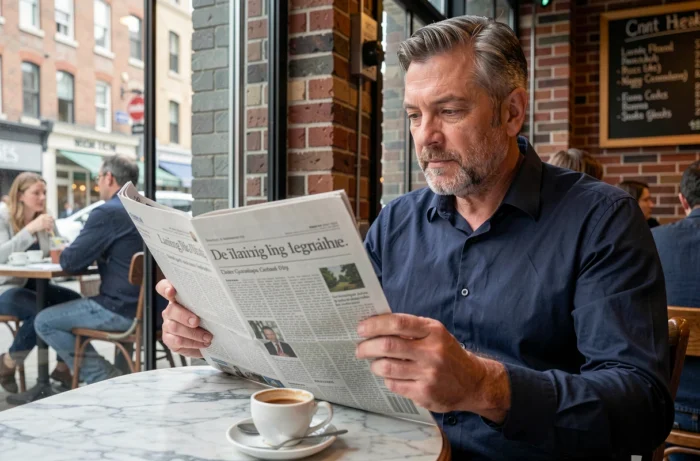
A daily news routine: combining media, creators, and AI tools
News creators are playing a distinctive role among younger audiences and in countries where trust in traditional media is lower, according to the same Reuters Institute report. Video creators, podcasters, and newsletter writers unpack a conflict or reform through their own lens.
The problem arises when this analysis becomes your only source. A creator chooses an angle, sometimes deliberately provocative, and may leave out aspects that don’t support their narrative. Cross-checking a creator’s coverage with a professional news outlet helps reduce this bias.
Three levels to work into your daily routine
- A quick scan: a five-to-ten-minute morning briefing (radio, podcast, or newsletter) that gives you the day’s basic facts without requiring a long reading session
- Targeted deep dives: choose one or two topics and read an in-depth article in a national newspaper or a magazine such as Le Monde Diplomatique to understand the causes and issues at stake
- Occasional fact-checking: when a figure or statement circulates on social media, trace it back to the primary source (an official statement, an international organization’s report, or a news agency dispatch)
This approach helps prevent information overload. You don’t read everything about everything. Scan broadly, then dig into a few topics.
AI-generated summaries: what they offer and where they fall short
The Reuters Institute reports that some users rely on AI tools to summarize articles or make them easier to understand. The practice is still relatively uncommon, but it’s growing. An AI-generated summary can save time when sorting through stories that deserve a closer read.
An automated summary is no substitute for consulting the sources. Summarizing means condensing, which can remove nuance, caveats, and sometimes conflicting data. On a complex geopolitical issue, territorial conflict, or trade negotiation, those nuances can make the difference between understanding and thinking you understand.
In practice, you can use an AI tool as a first-pass filter: it highlights the key points in a long article, and you can then decide whether to read the original. The rule of thumb is simple: never share or comment on a fact you’ve only read in an automated summary.
News fatigue: choose when to catch up instead of being swept along by the feed
Reuters Institute research tracks news avoidance and differences across countries and population groups. News fatigue isn’t a lack of interest; it’s a response to a constant stream of alerts, push notifications, and endlessly refreshing feeds.
The practical solution is simple. Set two times a day to catch up on the news, for example over breakfast and in the late afternoon, and turn off notifications the rest of the time. A set time for reading leads to better understanding than fragmented, constant monitoring.
Formats to suit the time you have
- Under ten minutes: a daily international news podcast (France Culture, France Info, and Radio France Internationale offer short formats)
- Fifteen to twenty minutes: read one in-depth article a day, chosen after your morning scan
- At the weekend: a weekly magazine or long-form piece that looks back on the week with perspective—a format French publications such as Courrier International and Le Monde Diplomatique do particularly well
Your routine will vary depending on your habits, but the principle remains the same: a regular, intentional check-in is better than being constantly exposed to the news.
Check information before sharing it: practical habits
You don’t need to be a journalist to carry out three basic checks. When a claim circulates on social media, first look at who posted it originally. An anonymous account with no track record isn’t as reliable as an established newsroom.
Next, check whether at least two independent sources are reporting the same thing. If only one website is sharing a sensational claim, the lack of confirmation from other media outlets is a warning sign. For images and videos, a reverse image search can help establish whether the visual really comes from the reported event or has been reused out of context.
These checks take less than two minutes. They can’t guarantee absolute certainty, but they do filter out most misleading content that spreads rapidly after a major event.
Building your own news routine—with regular time slots, trusted sources, and measured use of automated summaries—remains the most reliable way to understand what’s happening in the world without getting overwhelmed.