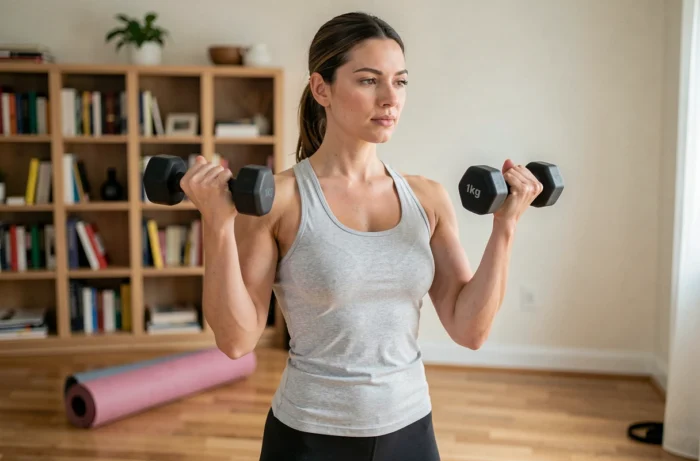
A 1 kg dumbbell is not suitable for every movement, and not every beginner needs one at the same stage. The American College of Sports Medicine’s official position (2009) sets a target of 8–12 repetitions per set for healthy novice adults: the load should allow them to reach this range with good form.
For some exercises, 1 kg is already more than enough in the very first session. For others, it becomes too light within a few weeks. Knowing the difference helps you avoid plateaus and injuries.
Exercises suited to 1 kg and movements to do without weights
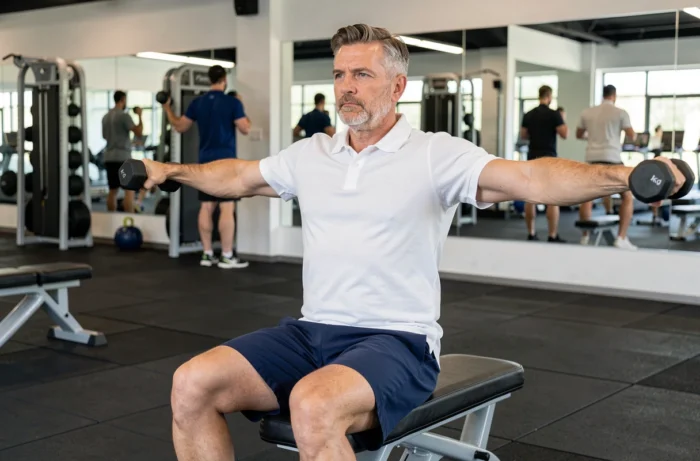
Whether a 1 kg weight is appropriate depends on the muscle group being worked and the lever arm created by the movement. In a lateral raise, the middle deltoid works at the end of the lever, far from the shoulder joint. A 1 kg dumbbell creates real resistance here, often enough to fatigue the muscle within 8–12 repetitions for a sedentary person.
The opposite is true for a goblet squat or bent-over row: the muscle groups involved (quadriceps, latissimus dorsi) are powerful, even in beginners. 1 kg provides no meaningful mechanical stimulus. In these cases, it is better to use body weight or move straight to a heavier load.
The National Institute on Aging recommends that beginners first practice movements without weights or resistance bands until the movements feel familiar. This is a point many general-interest articles overlook: adding 1 kg to a movement you have not mastered does not fix anything; it reinforces a faulty motor pattern. For a biceps curl or overhead triceps extension, where the range of motion is short and the risk of compensating is low, 1 kg is a sensible starting point.
Before deciding to use 1 kg dumbbells, assess each exercise individually rather than applying the same weight to your entire program.
- Lateral raises, front raises, external shoulder rotations: 1 kg is suitable for most sedentary beginners.
- Biceps curls, triceps extensions, flyes (lying chest flyes): 1 kg can work during the learning phase, but progression to 1.5 or 2 kg comes quickly.
- Squats, lunges, rows, presses: use body weight or a heavier load once you have mastered the movement.
Clear signs it is time to increase the load or put it down
The ACSM offers a simple guideline: when someone exceeds the target by one or two repetitions in two consecutive sessions, the load should be increased. With 1 kg dumbbells, this threshold is reached quickly on small isolation exercises. Being able to do more than 15 repetitions without feeling much effort means the stimulus is no longer sufficient.
Conversely, excessive shaking from the first few repetitions, an inability to maintain the full range of motion, or joint pain (as distinct from muscle fatigue) indicate that the weight is too much too soon. In that case, perform the movement without weights.
A common mistake: compensating instead of reducing the load
When 1 kg becomes difficult during a lateral raise, a typical compensation is to swing the torso to generate momentum. This shifts the load from the deltoid to the lower back. We recommend returning to the movement without weights, correcting your form, and then trying 1 kg again.
For people with a history of falls, vertebral fractures, or joint fragility, UK guidelines recommend professional supervision before using any load, however light. A 1 kg weight does not guarantee safety in these situations.
A structured progression with 1 kg dumbbells: frequency and volume
The Physical Activity Guidelines for Americans (2018) advise inactive people to start at a low intensity and then increase frequency before effort. In practice, this means a beginner is better off going from one workout a week to two than doubling their load.
The WHO (2020) recommends muscle-strengthening activities for all major muscle groups at least two days a week. A 1 kg routine can fit into this framework, provided it is not presented as a complete program: strength training complements aerobic activity; it does not replace it.
A sample workout in three stages
The first stage focuses on learning the movements: two sets of 8 repetitions across three or four exercises targeting the shoulders, arms, and upper back. The workout lasts about ten minutes. The second stage adds a third set and one more exercise. The third stage increases the load for movements where you can exceed 12 repetitions, while keeping 1 kg for fine isolation exercises.
This step-by-step progression avoids the classic trap of a fixed program where the same weight is used for months without adjustment. Sticking with a load that is too light is just as counterproductive as overloading.
1 kg dumbbells and realistic goals: what this weight can and cannot do
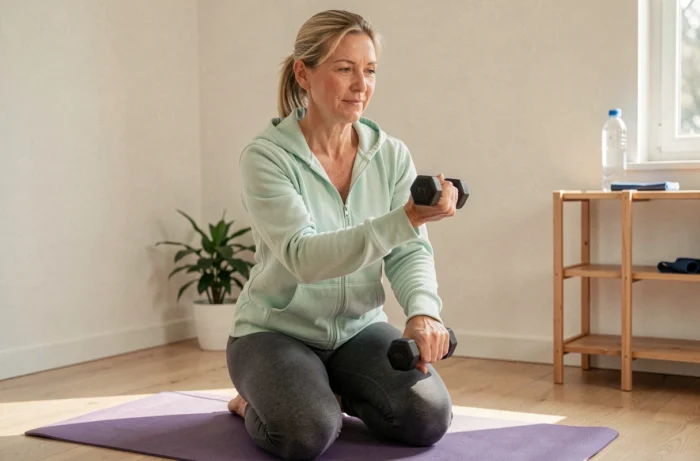
A 1 kg weight builds local muscular endurance in smaller muscle groups, improves upper-limb proprioception, and helps establish a regular routine. It does not produce significant hypertrophy or maximal strength gains, even for a complete beginner doing compound movements.
For people aiming to tone their arms and shoulders, this weight offers a good effort-to-results ratio during the first few weeks. After that, progress requires increments of 0.5 or 1 kg, or a switch to resistance bands with increasing resistance.
- Goals achievable with 1 kg: muscular endurance in the deltoids, biceps, and triceps; establishing a regular training habit.
- Goals requiring a heavier load: overall strength gains, lower-body strengthening, significant cardiovascular adaptation.
- Goals requiring professional advice beforehand: returning to exercise after an injury, bone fragility, diagnosed joint conditions.
A 1 kg dumbbell is a tool, not an end in itself. Its usefulness should be assessed exercise by exercise and week by week, based on your ability to maintain impeccable form throughout the target repetition range.