
A connected pelvic floor trainer is a vaginal (or anal) device equipped with sensors that measure pelvic floor muscle contractions and transmit the data to a mobile app. The term “connected” refers to its ability to provide real-time visual feedback, known as biofeedback, which sets these devices apart from passive models used with a basic electrical muscle stimulator.
Biofeedback or electrical stimulation: two technologies not to confuse
Comparison pages often mix up these two approaches. They address different clinical needs, and the choice between them is best discussed with a healthcare professional rather than based on the number of features listed in an app.
Biofeedback relies on voluntary contractions. The device detects muscle effort and translates it into a visual signal (a graph, game, or score). The main goal is to learn how to contract the pelvic floor correctly, not simply to strengthen it. A poorly directed contraction (bearing down with the abdomen instead of lifting the pelvic floor) can go unnoticed without this visual feedback.
Electrical stimulation, on the other hand, delivers a low-intensity current that triggers a passive muscle contraction. It is generally intended for women whose pelvic floor is too weak to initiate an effective voluntary contraction, or for certain specific cases identified in a clinical setting.
Choosing the right type of probe for long-term probing first requires determining whether the priority is motor control (biofeedback) or passive stimulation (electrical stimulation). Consumer connected devices (Emy, Perifit, Elvie) focus on active biofeedback, sometimes supplemented with electrical stimulation programs.
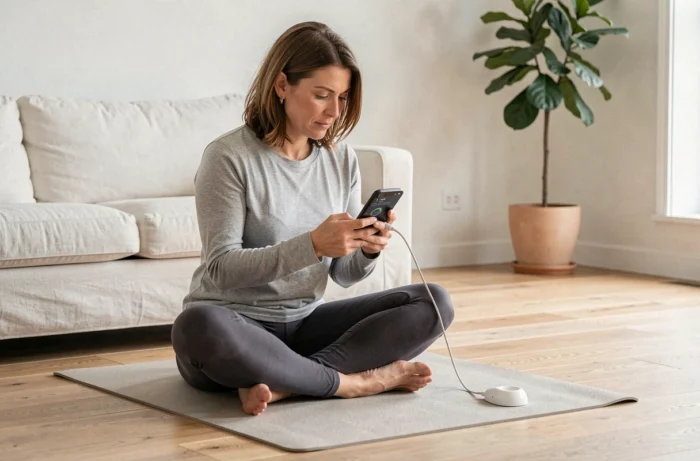
Connected pelvic floor trainer: practical selection criteria
Beyond the technology built into the device, several practical criteria can help guide your choice. Not all of them appear on product pages, and some only become apparent with use.
- Material and regulatory compliance: Medical-grade silicone free of phthalates is the standard. Also check whether the manufacturer explicitly states that the device is intended for medical use. In the European Union, the Medical Devices Regulation also covers software when it is intended for a medical purpose. A “connected” product is not automatically a compliant medical device.
- Quality of biofeedback: Some devices detect abdominal compensation (Perifit, in particular), while others focus on contraction strength. Detecting compensation is valuable for learning the correct technique, not just for making the muscle work harder.
- Ergonomics and anatomy: The device’s size, shape, and flexibility directly affect insertion comfort and measurement reliability. A compact model (such as Elvie) suits some anatomies, while a longer model provides better contact with the vaginal walls for other users.
- Personal data protection: Apps collect intimate data (session frequency, scores, and sometimes health information). Before buying, check what data the app collects, whether an online account is required, and how to delete your data.
Since May 28, 2026, four EUDAMED database modules have been mandatory in the EU. They cover the registration of economic operators and devices, notified bodies, and market surveillance. This regulatory reference point makes it possible to ask the manufacturer specific questions about the product’s status.
Knowing whether you are contracting correctly: the real purpose of a connected device
Most users buy a device to “strengthen the pelvic floor.” That’s only part of the picture. Strengthening a muscle that you are contracting incorrectly does not solve the problem and may even reinforce poor movement patterns (bearing down, or contracting the glutes or adductors instead of the pelvic floor).
Biofeedback from a connected device addresses this challenge directly: the graph on your phone screen shows in real time whether the contraction is rising or falling, and whether it is sustained or too brief. For a woman who has never had pelvic floor rehabilitation in a clinical setting, this visual feedback may reveal that she is bearing down instead of contracting.
This technical limitation raises a practical question: when should you choose professional support over independent training? Several situations warrant it.
- No sensation of contraction despite several attempts with the device.
- Persistent symptoms (urinary leakage, pelvic heaviness) after several weeks of regular use.
- Recent postpartum recovery, when an assessment by a physiotherapist or midwife can establish a diagnosis before any rehabilitation begins.
- Suspected prolapse or excessive muscle tone (hypertonicity), which contraindicates certain strengthening exercises.
Hybrid models that combine in-clinic follow-up with digital exercises at home offer an interesting way to maintain engagement between professional sessions. Some apps (such as the platform linked to Emy) also allow practitioners to provide remote follow-up.
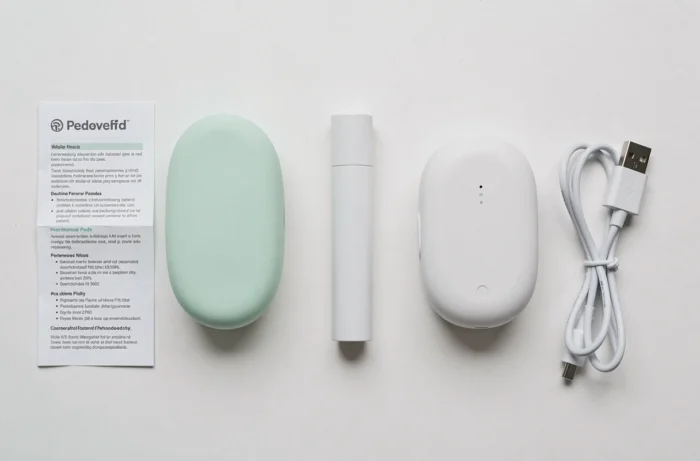
Emy, Perifit, Elvie: how they differ beyond the marketing
The three most widely used models in France all offer app-based biofeedback and medical-grade silicone. Their real differences lie elsewhere.
Developed in France by Fizimed, Emy focuses on sensor accuracy and offers a telehealth platform that connects users with a healthcare professional. It goes furthest in combining independent use with professional follow-up.
Perifit stands out for its dual sensor, which can detect abdominal compensation. For users starting out without professional guidance, this feature reduces the risk of poorly directed contractions. The app also includes a range of endurance programs.
Elvie prioritizes a compact design and discreet appearance. Its app is simpler, making it a good fit for users looking for short sessions without a steep learning curve. The trade-off is less detailed analysis of contractions.
None of these three devices replaces an initial assessment. A connected device is a training tool, not a diagnostic tool. For example, a hypertonic pelvic floor needs relaxation rather than strengthening, and no consumer app can detect this on its own. Starting with a specialist consultation remains the most reliable way to determine what type of rehabilitation to pursue and whether using a connected device independently is right for you.