The kindergarten curriculum published in the Official Bulletin on June 24, 2021, explicitly asks pupils to “cooperate, take on different complementary roles, compete, and develop strategies” in group games. Indoors, meeting this requirement involves specific challenges: limited space, cumulative noise levels, and a group with varying motor and cognitive abilities. Organizing a indoor group game that meets these objectives means working through the teaching variables before even choosing a game.
Adapting roles and instructions for the same group game in kindergarten
An indoor group game rarely works as is for every child in a class. Differentiation is not just about motor difficulty: it first concerns understanding the instructions and each player’s place in the activity.
Breaking instructions down into small steps (one action per sentence, one clear signal) gives children who need more processing time a chance to join in without falling behind. Making roles explicit—for example, using a colored scarf for the tagger and a clearly marked hoop as a safe zone—reduces cognitive load.
Providing ways to participate other than running or throwing can make all the difference for children with limited mobility or those who find the activity overwhelming: sound-signal caller, zone monitor, or scorekeeper. These are not substitute roles; they are strategic functions within the game, provided they are built into the rules from the outset.
Pairing children with trusted partners, where a more confident child supports a peer, can also make transitions between phases of the game easier. Every kindergarten group game benefits from having these adaptations planned before the session rather than improvised in the moment.
Room layout and noise management for indoor games
Noise is the most underestimated factor in indoor group games. When fast movement, spoken instructions, and children’s reactions overlap, noise levels rise quickly. Children who are sensitive to noise lose focus, and the teacher ends up shouting to be heard over the group.
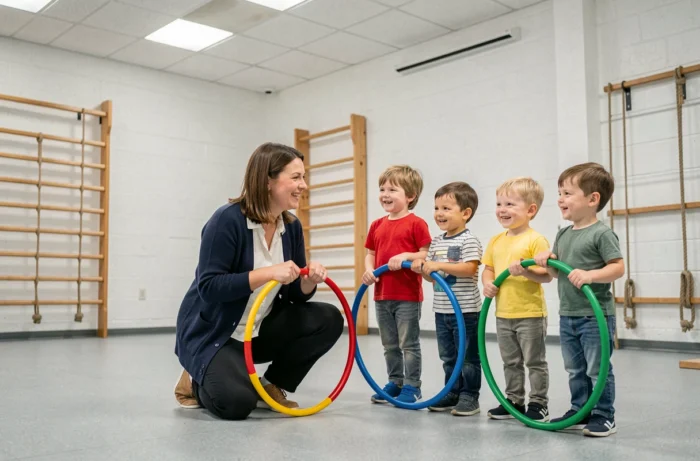
Separating the active area from the quiet area helps reduce the buildup. If the room layout allows, a quiet corner marked with a visual cue (a mat or sign) gives children a temporary break without excluding them from the game. They can rejoin when they are ready or switch to an observer role.
For safety, indoor chasing games and object-carrying games require clear pathways, stable furniture pushed against the walls, and non-slip surfaces. Marking the play area on the floor with colored tape or cones prevents collisions far more effectively than repeating verbal instructions.
Ten indoor group games, organized by skill
Rather than listing these games alphabetically, we have grouped them by their main learning objective. Each one works in a movement room or a cleared classroom.
Chasing and dodging games
- Midnight in the Sheepfold: a wolf calls out the time, and the sheep move freely until the “midnight” signal starts the chase. Adaptation: the wolf can be a pair, with one child giving the signal while the other chases.
- Wizards: players who are tagged are “frozen” and freed by a partner. An accessible role is to monitor the release zone and announce when players have been freed.
- Crocodile River: cross a marked area without being tagged by the crocodiles. For younger children, make the river narrower and slow the game down by using a sound signal between crossings.
Carrying and cooperation games
- The Movers: two teams carry objects from one area to another. Vary the motor skills involved by changing the objects (light, bulky, or requiring two hands).
- Empty the Baskets: each team empties its basket into the other team’s basket. Keep the play area small indoors so that routes stay short and the pace remains lively.
- Hot Balls: two teams stand on opposite sides of a line, and each team throws the balls back into the other team’s area. Indoors, use foam balls to reduce impact noise and the risk of injury.
Spatial awareness and signal games
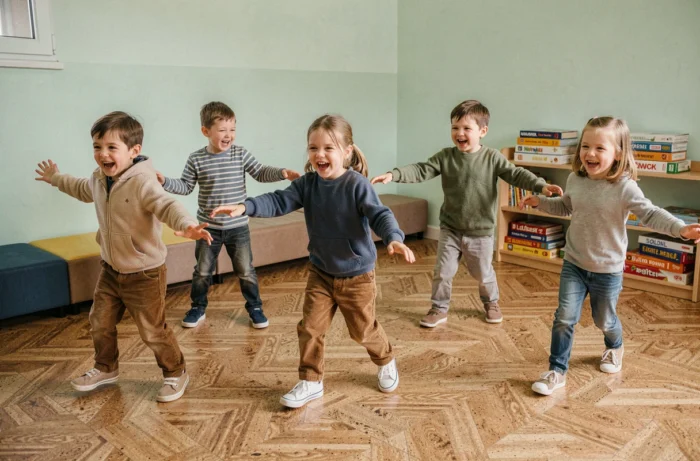
Three Safe Havens: at the signal, each child goes to a safe haven marked by a color or shape. This game develops visual discrimination and response to signals. For children who have difficulty understanding instructions, pair the sound signal with a gesture.
Color Dash: the teacher calls out a color, and players must touch an object of that color in the room. Adding a checker role to confirm choices strengthens the cooperative element.
Calm group games
Sitting Ball: players who are hit by the ball sit down and can intercept passes from the floor. This game works well at the end of a session because the pace naturally slows down.
Squirrel in a Cage: pairs form “cages” by joining their arms in a circle, with one squirrel in each cage. At the signal, the squirrels change cages. This game works in a small space and allows a child with limited mobility to be a “cage” without the role seeming passive.
Teaching variables for adapting these group games in the classroom
Each game above can be adapted along four dimensions: space (make the area smaller or larger), the number of players active at the same time, the type of signal (sound, visual, or gesture), and the rules for physical contact. Changing just one variable at a time makes it easier to observe the effect on the group before adding complexity.
In middle kindergarten, switching from a sound-only signal to a visual one (raising a scarf) changes the dynamic for children who process visual information more easily. In upper kindergarten, introducing a mandatory cooperation rule (carrying an object together or freeing a partner before scoring) encourages pupils to develop group strategies, in line with the curriculum’s expectations.
The goal is not to play more games, but to help the group progress through the same game by changing its parameters. Three sessions of The Movers with different adaptations lead to more learning than introducing a new game every day.