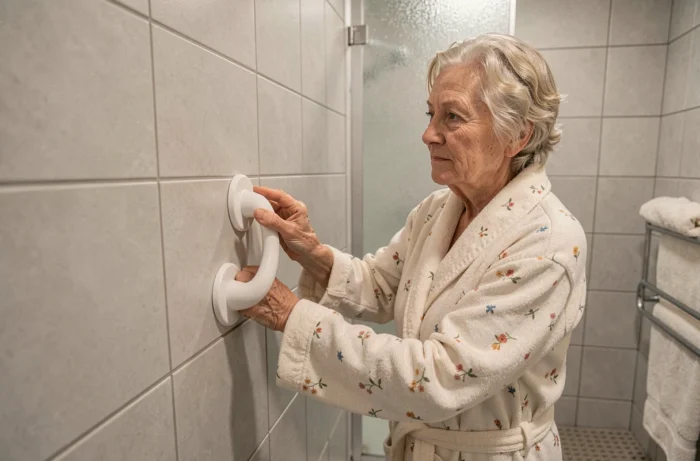
A suction grab bar is installed in the shower to avoid renovations, and the question quickly arises: does it really hold when you lean on it with all your weight? The answer depends less on the product than on the support, the installation, and the type of movement it is meant to assist. Before choosing a model, it’s essential to understand what a suction cup can (and cannot) withstand.
Manufacturer’s stated load and actual effort in the shower
Most suction grab bars display a load capacity, sometimes high. This figure corresponds to a lab test, on a smooth, clean, flat surface, with consistent vertical pull.
In a bathroom, the conditions are different. The bar is pulled sideways when getting up, it is grabbed suddenly if one slips, and a rotational force is exerted by pivoting the body. A weight stated by the manufacturer does not guarantee stability in real use, because the direction and intensity of the effort change everything.
A person hoisting themselves out of a bathtub exerts an oblique force that the suction cup is not designed to absorb as well as a perpendicular pull. This discrepancy between test conditions and usage conditions is the first point to keep in mind. A detailed analysis of this suction grab bar can be found on La Revue des Seniors, which documents the gap between technical promise and daily reality.
Installation surface: the real criterion for a suction grab bar’s stability
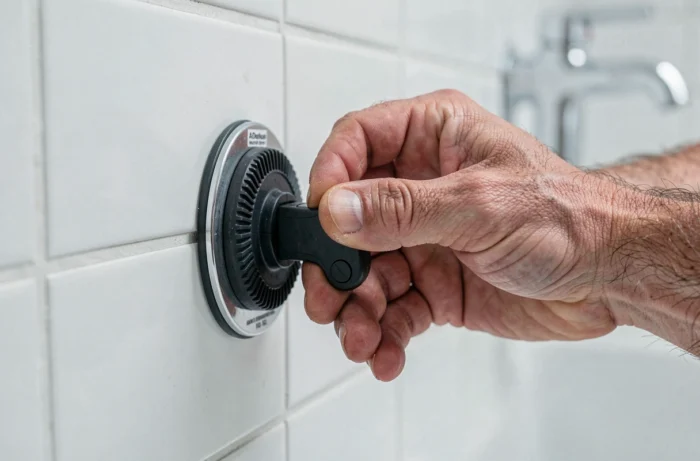
A suction cup needs a perfectly smooth, non-porous surface without grout to create the air vacuum that holds it in place. In practice, this limits compatible supports.
Surfaces that work
- Glazed tile (smooth, shiny, without relief) offers the best adhesion, provided the tile is large enough to accommodate the entire suction cup without overlapping a grout line
- Tempered glass shower walls are also suitable, but the bar must not obstruct the opening or create a pressure point on a corner
- Smooth acrylic or laminated PVC wall panels hold properly if the surface is neither bulging nor textured
Surfaces to avoid
Textured anti-slip tiles, mosaics (too many grout lines), porous natural stone, micro-textured polished concrete, and painted plaster do not allow for sufficient vacuum creation. On these surfaces, the suction cup will eventually give way, sometimes at the worst moment.
A simple test before trusting the installation: attach the bar, wait 24 hours without touching it, then pull firmly on it. If it moves or makes a suction noise, the support is not suitable.
Suction bar or screw-mounted bar: when to prefer one over the other
The suction bar has a real advantage: it requires no drilling or assessment of the wall behind the tiles. For a temporary stay (recovering from surgery, visiting a relative), it is a quick and reversible solution.
For daily and long-term use, the screw-mounted bar remains more reliable. The assessment of the support behind the tiles is then crucial: concrete, hollow brick, or drywall do not require the same anchors or techniques. A bar screwed into a lightweight wall with inappropriate anchors can give a false sense of security, just as a suction cup on an unsuitable support can.
The choice is therefore not limited to suction versus screws. It depends on the duration of use, the nature of the wall, and the movement the bar is meant to assist. Standing in the shower in stable balance requires less from the fixture than hoisting oneself out of a bathtub.
Criteria for choosing a reliable suction grab bar
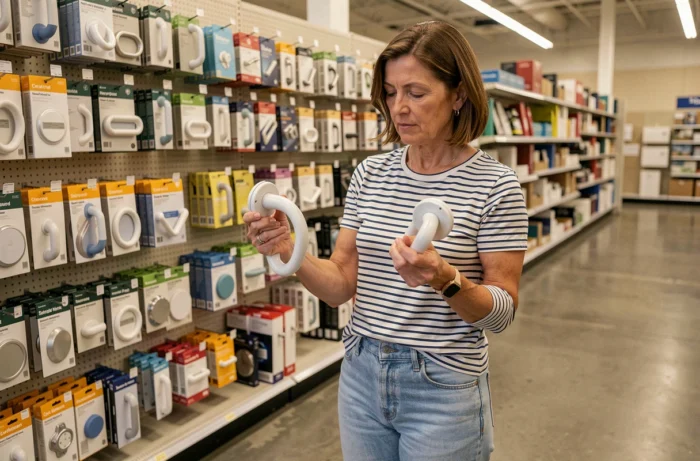
Beyond the support, several parameters separate a decent model from a risky purchase.
The diameter of the tube is as important as the fixture. A bar that is too thin is difficult to grip when hands are wet or when grip strength decreases. A comfortable diameter, generally around 30 to 35 mm, is ideal for a secure hold.
The non-slip coating on the gripping area makes a real difference in a humid environment. A bare stainless steel tube becomes slippery in the shower. Models with textured or rubberized zones offer superior grip.
The length depends on the intended location. A short bar is suitable next to the toilet or as a supplement in a narrow shower stall. For support along a bathtub, a longer bar (over 40 cm) distributes the effort better across the suction cups.
The suction cup’s locking mechanism varies by brand. Lever models provide visual control: lever in the closed position, suction cup active. Some include a color indicator that turns red when adhesion weakens, allowing for rechecking the installation before an incident occurs.
Limitations to be aware of: a bar alone is not enough to secure the bathroom
A grab bar addresses only one aspect of the fall risk. It provides an anchor point for stabilization, but does not correct a slippery floor. An anti-slip mat in the bottom of the shower or bathtub significantly enhances protection.
For someone who tires easily while standing, the bar does not replace a shower seat. The choice should start from the riskiest daily movement (getting up, stepping over, pivoting) and combine several pieces of equipment rather than relying solely on one accessory.
The suction cup remains a compromise between ease of installation and level of safety. For permanent use in a home adapted for aging, switching to a wall-mounted fixture with prior assessment of the support remains the most robust solution. The suction bar retains its relevance as a transitional solution, when traveling or in a home where drilling is not possible.