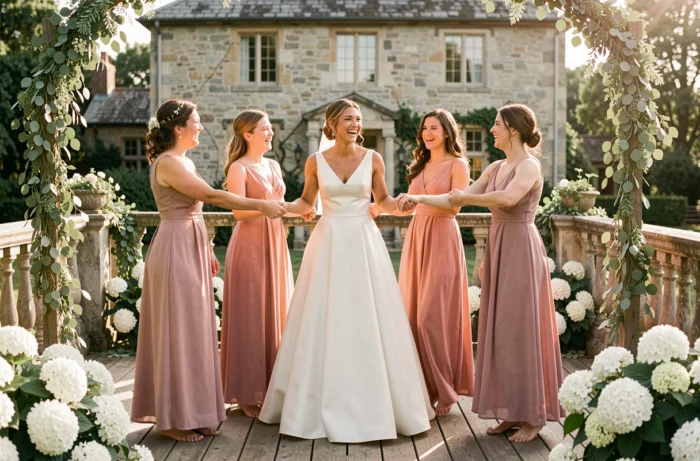
When it comes to distributing wedding tasks, the first challenge isn’t finding volunteers, but knowing who does what without stepping on anyone’s toes. The bridesmaids play a central role in the preparations and the ceremony, but their role remains unclear for many brides. Clarifying the missions, setting a financial framework, and coordinating the procession in advance helps avoid most tensions on the big day.
Civil witness and bridesmaid: two distinct roles to assign separately
The two functions are often confused because they overlap on the day of the ceremony. In France, a civil marriage requires two to four witnesses who sign the register at the town hall. Bridesmaids, on the other hand, have no legal obligation: their role is emotional and logistical.
This distinction changes how the procession is composed. A close friend can be a wonderful bridesmaid (organized, available, supportive) without being an official witness. Conversely, a civil witness may only be responsible for signing without participating in the preparations. Separating the legal function from the emotional role allows for choosing each person based on what they truly bring, not out of obligation.
In practice, civil witnesses are announced first, then the role of bridesmaid is offered to those who want to get involved in the organization. The resources available on lademoiselledhonneur.fr detail typical missions to frame expectations from the start.
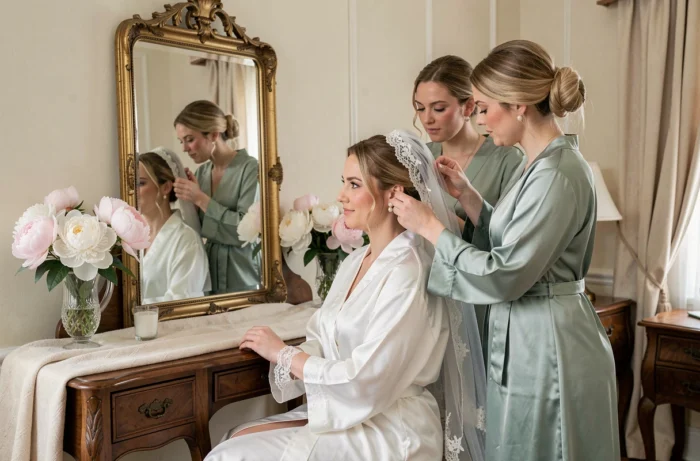
Bridesmaid budget: setting the rules before choosing dresses
The coordinated dress, shoes, hairstylist, makeup, participation in the bachelorette party, sometimes travel: expenses can quickly add up for a bridesmaid. According to the Mariages.net survey, the average budget for a wedding with one hundred guests exceeded 19,000 euros in 2025. This amount concerns the couple, but it reminds us that the costs of the procession deserve an honest discussion in advance.
Three common scenarios emerge:
- The bride covers the dresses and accessories, while the bridesmaids pay for their hair and makeup.
- Each bridesmaid chooses her own outfit from a defined color palette, which distributes costs and avoids frustrations related to a single cut.
- The couple offers a gift (jewelry, personalized accessory) to offset some of the expenses incurred by the procession.
The most effective approach is to send a group message as soon as the team is formed, specifying what is covered and what is not. This way, a friend avoids accepting the role out of affection only to realize later that the cost exceeds what she can afford.
Coordination of preparations: distributing tasks according to actual skills
Assigning the same list of tasks to all bridesmaids is the best way to achieve no results. Time is saved by identifying what each person does well, then assigning specific missions.
Logistical tasks on the wedding day
Welcoming guests, distributing ceremony booklets, coordinating with the photographer for group portraits, managing last-minute seating plans: these tasks require someone methodical and comfortable with unexpected situations. Designating a “master of ceremonies” bridesmaid who centralizes information prevents five people from calling the caterer at the same time.
Creative tasks in advance
Decorating the venue, preparing gifts for guests, organizing the bachelorette party: these tasks suit those who have time and creative energy in the weeks leading up to the wedding. Deadlines should be formalized in a shared document, not in a group chat where messages can get lost.
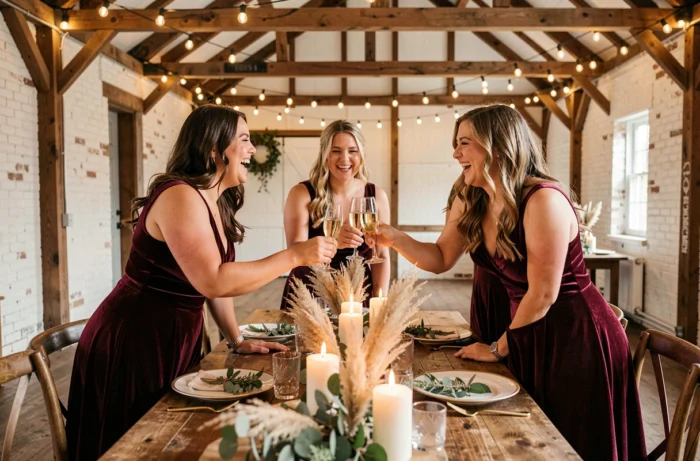
A often-overlooked point: inform each bridesmaid of the precise schedule for the day at least two weeks in advance. Arrival time, preparation location, ceremony flow, key moments (speeches, bouquet toss, first dance). Without this document, even the most motivated will improvise.
Choosing dresses and procession color: starting from the venue, not a mood board
Most articles advise starting with a color palette inspired by Pinterest. In practice, it is observed that selection works better when starting from the reception venue. A room with light stone walls does not call for the same shades as a lush garden or an industrial loft.
For bridesmaid dresses, two approaches yield good results:
- A single color with different cuts, so that each finds a flattering silhouette while maintaining visual coherence in group photos.
- A gradient of similar tones (from dusty rose to terracotta, from sage to forest green), creating a harmonious effect without strict uniformity.
- An identical fabric offered in several models, simplifying bulk orders and reducing discrepancies in appearance.
The usual point of tension concerns body shape. Imposing a single model on different body types almost always generates frustrations. Offering two or three cuts approved by the bride in the same color solves the problem without sacrificing the aesthetic of the procession.
Gifts and attention for bridesmaids: what matters on the big day
The procession invests time, money, and emotional energy. A tangible thank you makes a difference. We’re not talking about an expensive gift, but a personal gesture: a handwritten letter read privately, a piece of jewelry worn during the ceremony, an item related to a shared memory.
Timing is as important as the gift itself. Presenting the gift the night before the wedding, during a quiet moment between the bride and her bridesmaids, creates a distinct memory from the day’s excitement. Handing it over amidst the morning rush of preparations, between two strokes of a straightener, dilutes the intention.
Also consider comfort throughout the day: prepare an emergency kit (pins, foot band-aids, spare tights, stain removers), a snack for the gap between the ceremony and the meal, and a break where the bridesmaids are not on duty. The procession holds up better throughout the day when breaks are planned, rather than when responsibilities are multiplied without respite.
A successful wedding with bridesmaids relies less on the perfect aesthetic of the procession than on the clarity of roles, respect for each person’s budget, and a few well-placed gestures of appreciation. The rest, the camaraderie, the laughter during preparations, the tears during the ceremony, comes naturally when the framework has been established.