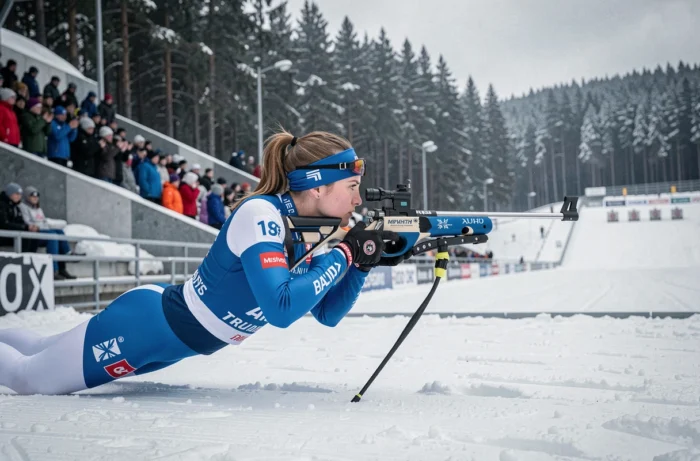
The 2025–2026 women’s biathlon World Cup overall standings came down to a razor-thin margin between the top two. Lou Jeanmonnot and Franziska Preuss battled for the yellow bib right through the final stage, with the overall title still up for grabs for almost the entire winter.
The closeness of the overall standings raises a specific question: does the big crystal globe primarily reward consistency across the full calendar, or does it also reflect performance gaps between the different biathlon disciplines?
Points scored and gaps between the leading athletes in the women’s biathlon overall standings
The battle for the yellow bib was one of the closest in recent seasons. Lou Jeanmonnot held the lead in the overall standings for much of the winter, but watched her advantage shrink as the stages went by. The women’s biathlon overall standings reflect a fight decided point by point, where every missed race or podium finish carried significant weight.
Franziska Preuss applied constant pressure, cutting the gap to just a few points before the final stage. In a system where points are awarded for finishing position in every race, a margin this small can come down to a single place on the podium. The slightest lapse at the shooting range or a poor wax choice could have changed the standings.
| Athlete | Nation | Overall position | Late-season trend |
|---|---|---|---|
| Lou Jeanmonnot | France | 1st (yellow bib) | Lead narrowed but held |
| Franziska Preuss | Germany | 2nd | Steady climb over the final stages |
| Julia Simon | France | Top 5 | Occasional wins, discipline globes |
| Elvira Öberg | Sweden | Top 10 | Regular mass start podium finishes |
Consistency versus wins: what the big crystal globe really measures
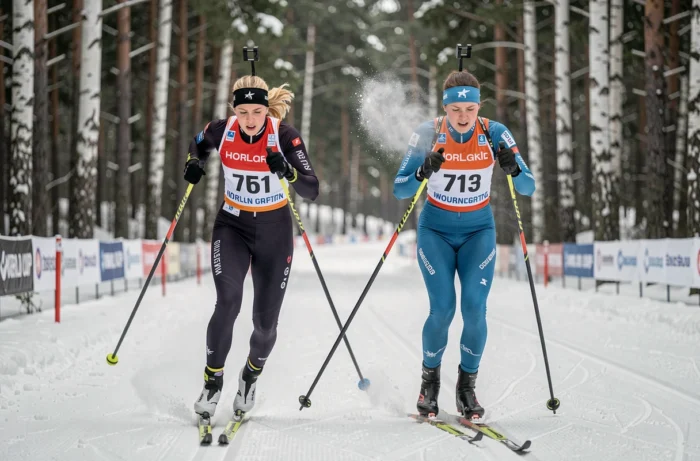
The overall standings do not necessarily crown the athlete with the most race wins. They reward the athlete who scores points at every start, across all disciplines (individual, sprint, pursuit, mass start, relay). This distinction is clear in Lou Jeanmonnot’s profile: her strength lies in consistently finishing near the top, even when she does not win every time.
Julia Simon offers a different profile. Her mass start victories showcase her ability to deliver a standout performance in a single race. Winning the mass start—the most competitive and unpredictable format—requires a combination of explosive skiing and composure on the range that few biathletes can match.
But these emphatic wins are not always enough to make up for one or two disappointing results elsewhere in the calendar. The big crystal globe rewards consistency throughout the entire season, not isolated flashes of brilliance. An athlete who regularly finishes between second and sixth will often score more points than one who alternates between wins and finishes outside the top 15.
Biathlon discipline globes: dominance also varies by event
The overall standings tell only part of the season’s story. The crystal globes for each discipline (sprint, pursuit, individual, mass start) can reveal different dominant athletes from the overall leader. The split between Lou Jeanmonnot and Julia Simon is a good example.
- Lou Jeanmonnot built her season on strong results across all disciplines, allowing her to lead the overall standings without necessarily winning every discipline globe
- Julia Simon excelled in specific formats, particularly the mass start, thanks to remarkably effective standing shooting and tactical management of the final laps
- Elvira Öberg regularly reached the podium in the sprint and pursuit, confirming her status as the circuit’s third force
- Franziska Preuss capitalized on one of the fastest cross-country skiing speeds in the field, making up for shooting that was sometimes less precise than that of her French rivals
This distribution shows that the pecking order changes depending on the race format. The sprint (a short race with two shooting stages) favors fast skiers who keep mistakes to a minimum. The mass start (a group start with four shooting stages) favors consistent shooters who can handle the pressure of a tightly packed field.
How shooting affects consistency in the standings
Shooting remains the biggest factor in overall consistency. Every missed shot means a penalty loop, costing several seconds on the clock. Over a full season, biathletes who maintain a high shooting percentage hold their position far more reliably than those who try to make up for mistakes with speed on the skis.
Lou Jeanmonnot built her lead on precisely this reliability at the range. Julia Simon, whose prone shooting was less consistent at times, lost valuable overall points in some sprint and individual races, despite delivering top-level performances in other events.
France’s team and the women’s biathlon nations standings
Having two French athletes at the top of the individual standings did not automatically translate into dominance in the nations standings. France led the women’s relay standings, but the Nations Cup takes into account results from the entire team, not just its two strongest athletes.
The Scandinavian nations (Sweden and Norway) and Germany have greater squad depth, allowing them to score points consistently with four or five athletes. France, by contrast, relies mainly on Jeanmonnot and Simon to keep its tally moving. France’s individual strength was not enough to secure every team title.
This gap between individual performances and collective strength highlights a structural challenge for French biathlon: developing a third, or even fourth, athlete capable of regularly staying in the world’s top 20. Without that depth, the relay remains competitive thanks to its two leaders, but France can lose out in the Nations Cup over the course of a full season.
The 2025–2026 season confirmed that the women’s big crystal globe is won race by race, not stage by stage. The final margin between Jeanmonnot and Preuss, still razor-thin to the end, is a reminder that in modern biathlon, a single missed shot on a Sunday in January can decide the standings in March.