An orange warning light that comes on the highway on a Sunday evening, 200 km from home, with the garage closed until Tuesday. Most avoidable breakdowns start with a signal ignored for weeks. Maintaining your car daily is not just ticking off a checklist: it’s about spotting the concrete signs that precede a breakdown and acting before they escalate.
Brake Wear and Disc Condition: What Regenerative Braking Changes
On a conventional vehicle, brake pads wear down quite predictably based on mileage and driving style. It’s known that they need to be checked, and most drivers wait for the characteristic metallic noise to worry about it.
On an electric car, the situation is different. Regenerative braking reduces the strain on mechanical brakes, which seems like an advantage. But underused discs can corrode due to lack of use, especially in humid or coastal areas. You then end up with nearly new pads mounted on pitted discs, which degrades braking performance.
In practice, it is recommended to visually inspect the discs during every tire change, even if the mileage seems low. A persistent rust film after a few hard stops warrants a trip to the workshop. To delve deeper into maintenance specifics based on your engine type, you can access Nouvelle Dimension auto and compare manufacturer recommendations.
Engine and Transmission Fluids: Prioritizing Checks Based on Urgency
All competitors list the fluids to check. The real question on the ground is in what order to address them when you don’t have the time or budget to do everything at once.
Coolant Takes Precedence Over Engine Oil in Summer
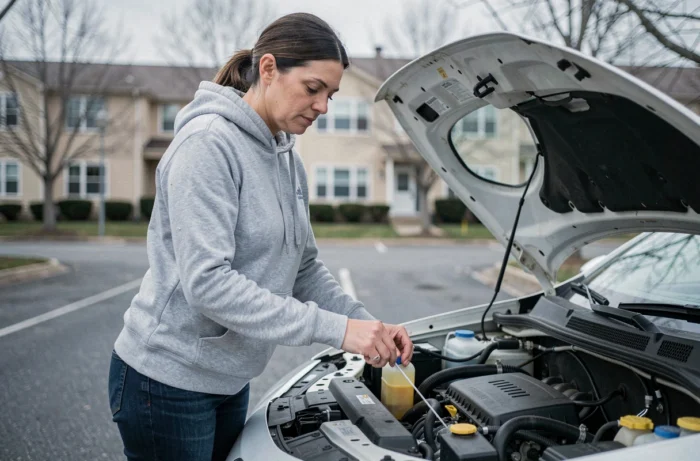
An overheated engine can cause irreversible damage in just a few minutes. Checking the coolant level takes less than thirty seconds, with the hood open and the engine cold. The translucent reservoir with min/max markers is visible without tools.
Engine oil, on the other hand, tolerates a slight delay in changing better than a lack of cooling during a heatwave. That doesn’t mean we neglect it: we check the dipstick once a month and adhere to the oil change interval in the maintenance booklet.
Brake Fluid: A Common Oversight
Brake fluid absorbs moisture over time. Old fluid lowers the boiling point, which can cause spongy braking during prolonged descents. Most manufacturers recommend a replacement every two years, but many drivers find that they have never had it changed.
During routine maintenance, asking for a check of the brake fluid’s moisture level (with an electronic tester, a quick operation in the workshop) allows you to know if replacement is truly necessary rather than paying by default.
Tire Pressure and Technical Inspection: The Weight of Local Climate
The technical inspection reveals significant disparities between French regions. The age of the vehicle fleet, access to garages, as well as exposure to humidity, de-icing salt, or degraded roads play a role in rejection rates.
For a driver, this means that preventive maintenance must take local usage conditions into account. By the sea or in the mountains, undercarriage corrosion progresses faster. Regularly washing the undercarriage after winter or after driving on salted roads limits damage to brake lines and suspension mounts.
Tire Pressure and Asymmetrical Wear
An under-inflated tire wears more on the sides. An over-inflated tire wears in the center. In both cases, you lose grip and risk a rejection during the technical inspection for irregular wear.
- Check the pressure when cold at least once a month, referring to the label affixed to the driver’s door frame (and not to the value printed on the tire sidewall, which indicates the maximum pressure)
- Visually inspect the sidewalls for bulges, cuts, or cracks, signs of a tire that needs replacing even if the tread appears fine
- Rotate the front/rear tires according to manufacturer recommendations to even out wear, especially on front-wheel drives that put more strain on the steering wheels
Reused Parts and Car Maintenance: An Underutilized Option
When a repair is necessary, the usual reflex is to order a new original part. The cost of car repairs is steadily increasing, and this budget item pushes some drivers to defer necessary interventions.
Reused parts (from end-of-life vehicles, inspected and resold) represent a concrete alternative for items like headlights, mirrors, alternators, or air conditioning compressors. A tested reused alternator often costs two to three times less than a new original alternator, for a comparable lifespan if the part is properly selected.
The limit concerns safety parts: for brake discs, shock absorbers, or steering components, we prefer new or remanufactured parts with a warranty. Reuse works well for electrical components and body parts, but less so for items directly related to road handling.
Pollution Warning Light and Technical Inspection: Don’t Try to Mask the Problem
A lit engine warning light, often related to the pollution control system, does not necessarily mean a heavy repair. But trying to erase it without diagnosis amounts to postponing a problem that will worsen. A simple faulty oxygen sensor can be enough to trigger the light, and its replacement remains affordable.
Before a technical inspection, it’s better to have the fault codes read by a diagnostic tool (available in most garages, and even via OBD devices accessible to individuals). This allows you to distinguish a minor fault from a catalyst or EGR valve issue that will require a larger budget.
- A light that has been on for several weeks often indicates a stabilized fault: the diagnosis is all the more reliable
- Erasing the code without repairing does not fool the inspector, who checks the consistency of the engine data
- Some pollution faults cause measurable fuel overconsumption, which justifies intervening even outside the inspection period
Daily car maintenance relies less on a long list of actions than on the ability to spot what really matters based on the vehicle, its mileage, and its environment. A driver in a coastal area does not have the same priorities as an urban driver who drives little. Adapting checks to actual usage remains the best way to avoid unpleasant surprises at the garage.