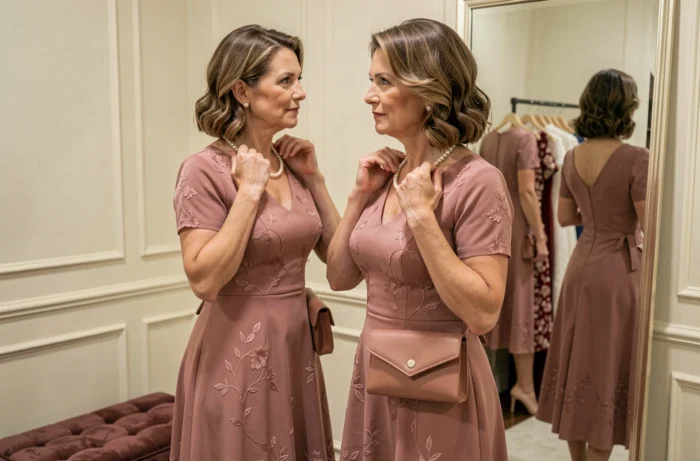
Choosing a dress for your son’s wedding raises a question that is rarely articulated clearly: how to find an outfit that respects the couple’s dress code, fits the ceremony location, and remains comfortable for an entire day, sometimes lasting more than ten hours? Rather than starting from a personal style, it’s more reliable to begin with the actual constraints of the event and then refine.
Criteria for Choosing a Ceremony Dress According to the Type of Wedding
The venue, season, and level of formality weigh differently in the decision. The table below summarizes the variables that directly influence the choice of cut, fabric, and color.
| Criterion | Civil or Town Hall Wedding | Religious Ceremony or Castle | Outdoor Wedding (Garden, Beach) |
|---|---|---|---|
| Level of Formality | Semi-formal | Formal | Casual to Semi-formal |
| Appropriate Dress Length | Midi or knee-length | Long or midi | Midi, flowing |
| Preferred Fabrics | Crape, lightweight gabardine | Chiffon, satin, lace | Linen, structured cotton, voile |
| Colors to Avoid | White, ivory | White, ivory, total black | White, ivory |
| Useful Accessory | Structured clutch | Shawl or jacket to cover shoulders | Block-heeled or wedge shoes |
The most underestimated factor concerns the ground. An outdoor ceremony on grass or sand makes thin heels impractical. Choosing shoes suitable for the terrain avoids compromising both appearance and comfort.
When the invitation specifies a color code or theme, the couple’s guidelines take precedence over any general dress code. In case of doubt about the interpretation, it’s better to ask the couple directly rather than guess.
Colors and Dress Cuts Suitable for the Mother of the Groom
Finding the right dress for my son’s wedding requires moving beyond the safety reflex that leads to navy blue or gray. These shades work, but they are not the only reliable options.
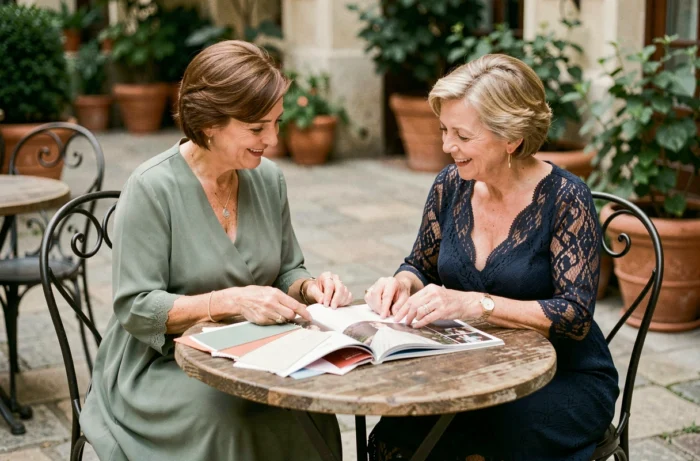
When it comes to colors, white and ivory remain reserved for the bride, regardless of the wedding style. Total black, without an accessory to break the sobriety, can give a too austere impression at a religious ceremony. Outside of these limits, the spectrum is wide.
- Pale tones (dusty pink, sage green, sky blue) are suitable for spring and summer ceremonies without risking overshadowing the bride.
- Deep colors (burgundy, midnight blue, emerald green) are better suited for fall and winter weddings, especially indoors.
- Subtle prints (small flowers, fine geometric patterns) work for country weddings, provided the dress’s base remains in a dominant solid shade.
For the cut, a dress tested in motion is better than a dress chosen in front of a mirror. A practical guide recommends checking the fit while sitting, raising arms, walking, and climbing stairs. A wedding day alternates between long periods of standing, seated meals, and moving between several locations.
Adapting the Outfit to the Different Highlights of the Day
A wedding often includes several sequences that do not require the same level of formality. The town hall ceremony, religious or civil ceremony, cocktail hour, and dance party represent distinct contexts.
Planning for a modular piece (shawl, short jacket, bolero) allows for covering shoulders in a place of worship and then removing it at the cocktail. This single piece can transform the silhouette from one highlight to another without requiring a complete change.
A common pitfall: choosing a dress designed solely for the ceremony and ending up uncomfortable at dinner or the evening party. A slightly flowing cut below the waist offers more leeway than a strict sheath dress, especially if the meal lasts several hours.
Ceremony Shoes and Accessories: Choices That Change Comfort
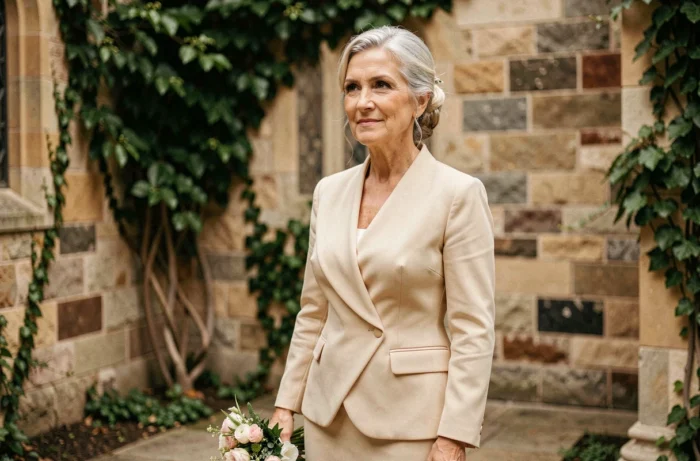
Accessories are not just for completing a look. They solve concrete problems that the dress alone does not cover.
Shoes deserve the same attention as the dress. A heel worn for eight hours straight, sometimes on uneven surfaces, can turn the end of the day into a trial. A block heel of a few centimeters remains stable on most terrains and offers a compromise between style and endurance.
- A medium-sized clutch (not too small) allows you to keep your phone, tissues, and makeup touch-ups without being cumbersome.
- Subtle jewelry avoids competing with the bride’s adornments: fine earrings, simple bracelet, or delicate necklace are sufficient.
- A shawl or stole in a coordinated fabric serves both as protection against air conditioning or wind, and as a style piece.
A detail often overlooked: the color of the shoes. Shoes in a nude tone close to the skin tone visually elongate the silhouette and pair with almost any dress color.
Ceremony Dress for the Mother of the Groom: Mistakes to Spot Before Purchase
Some mistakes are only visible once the dress is worn in real conditions. Buying a dress without trying it while sitting is the source of most unpleasant surprises.
A fabric that is too thin without lining can become transparent under strong natural lighting. Wedding photos, taken outdoors with flash or backlighting, reveal what the fitting in the store masks. Checking the opacity of the fabric in daylight, with arms extended in front of a window, takes ten seconds and avoids lasting regret.
Last point: coordinating your outfit with that of the father of the groom does not mean matching exactly. A color reminder in an accessory is enough to create visual coherence in family photos without giving the impression of a uniform. A pocket square, tie, or brooch in the same shade serves this purpose.
The final choice rests on a trade-off between three constraints that are rarely compatible from the outset: respecting the framework set by the couple, feeling comfortable throughout the event, and wearing an outfit that you truly love. Starting from the dress code and the venue, then adjusting the cut and color to your own tastes, remains the most reliable method to avoid shaky compromises.