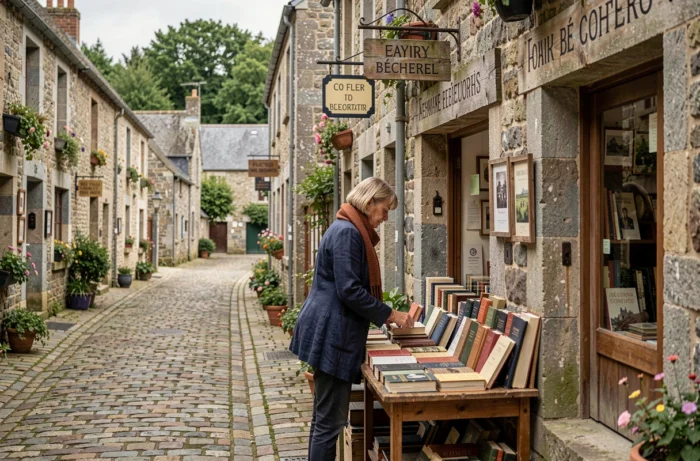
Bécherel is more than its bookshops. The area surrounding this small town of character brings together built heritage undergoing restoration, a cultural program focused on ecology, and local industries that connect the land with books. This combination, rarely treated as a coherent whole, is what makes the Pays de Bécherel unique in the Breton landscape.
Bécherel’s ramparts: built heritage that needs repairs, not just visits
Bécherel’s ramparts are often presented as a picturesque backdrop. The reality is more technical: safety work has begun to stabilize sections weakened by age and water infiltration. This project is a reminder that Breton medieval heritage requires ongoing structural maintenance, far beyond simply enhancing it for tourism.
This preservation work changes the way visitors experience the site. Walking along the ramparts also means observing the condition of the masonry, spotting repointed joints and identifying recent reinforcements. The area acknowledges that the work is ongoing rather than trying to hide it.
Information about municipal and intermunicipal projects is available at https://cc-paysdebecherel.fr/, which details the community of communes’ responsibilities for heritage, urban planning and quality of life.
Maison du Livre in Bécherel: cultural programming and awareness of the natural world
The Maison du Livre is about more than literary festivals. Its program includes events focused on ecology and the natural world, such as musical theater performances about birds and discussions on cultural ecology held in the town’s market halls.
This focus makes Bécherel an unusual case in Brittany. While most book towns stick to secondhand book markets and author signings, Bécherel connects books with local ecological issues. Workshops and performances are not peripheral activities: they shape the cultural season.
The approach to cultural ecology here treats nature as a subject for creative work and public debate, not merely as a landscape to admire. It attracts visitors who might not come for a book festival alone.
Events that showcase this dual purpose
- Children’s performances about local wildlife at the Maison du Livre, combining music with nature observation
- Cultural ecology events at the market halls, featuring local stakeholders discussing farming practices and biodiversity
- Seasonal gatherings bringing publishers, authors and local producers together around books and regional products
Local produce and books in the Pays de Bécherel: an interconnected local economy
Bécherel’s market halls host farmers’ markets, exhibitions and literary events in turn, illustrating a model in which agricultural industries and cultural life share the same spaces. This shared use is no small detail: it brings different audiences together.
Foie gras, free-range poultry and local market-garden produce are sold alongside books from the town’s bookshops. This connection between food and culture creates a visitor experience that is hard to find elsewhere in Brittany.
What this model means for visitors
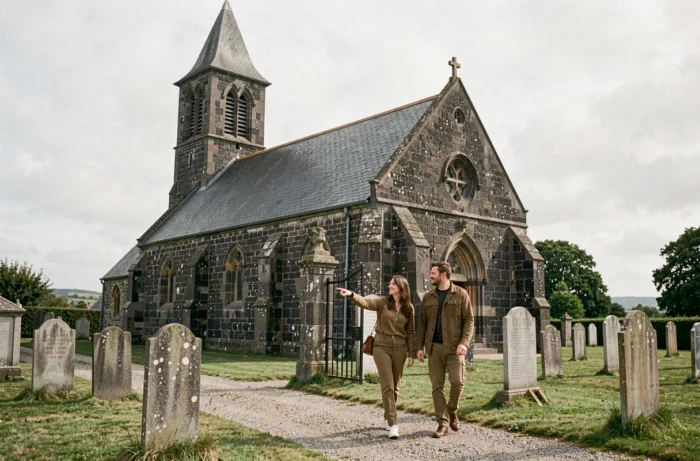
A stay in the Pays de Bécherel doesn’t split neatly into a “heritage day” and a “nature day.” The two overlap. You can walk from the ramparts to a bookshop, then to a local producer’s stall, without even changing streets. The area is easy to explore on foot, with built heritage, cultural attractions and local food networks all along the way.
This concentration of activities within a small area is a real advantage for visitors with half a day or a full day to spare. There’s no need to make multiple car trips between scattered sites.
Natural setting of the Pays de Bécherel: bocage and the landscapes of Ille-et-Vilaine
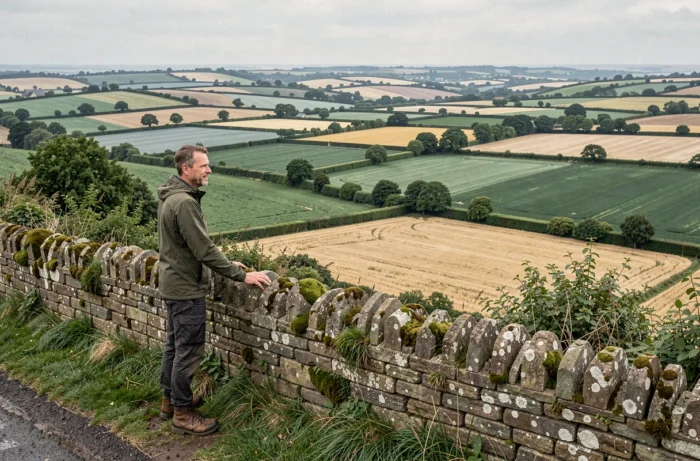
The landscape around Bécherel is typical of the inland Breton bocage. Hedgerows, sunken lanes and meadows shape an area where everyday biodiversity remains its greatest natural asset. Restored washhouses in neighboring communes reflect a longstanding relationship with water and wetlands that local authorities are working to preserve.
This bocage is not spectacular in the conventional tourist sense. It cannot compete with the cliffs of Fréhel or the heathlands of Côtes-d’Armor. Its value lies in its ecological continuity and the quality of the wildlife corridors between farmland plots.
- Signposted hiking trails cross the bocage and connect hamlets with villages, offering views over the countryside of Ille-et-Vilaine
- Restoration projects for washhouses and small hydraulic structures help maintain the network of wetlands
- The nearby Montauban Forest adds woodland to the landscape of hedgerows and meadows
The Pays de Bécherel is a place where built heritage, cultural programming focused on the natural world, and local agricultural industries reinforce one another. This interconnectedness, more than any single element on its own, defines the area’s identity. Visiting Bécherel without considering all three dimensions means seeing only a third of what it has to offer.